Crystal Meanings: A Complete Guide to 9 Popular Stones
Most people don’t come to crystals through a textbook. Someone gives you a little purple stone for your birthday, or a bracelet catches your eye at a market, and suddenly you want to know what it is. Then you want to know why people have cared about it for thousands of years.
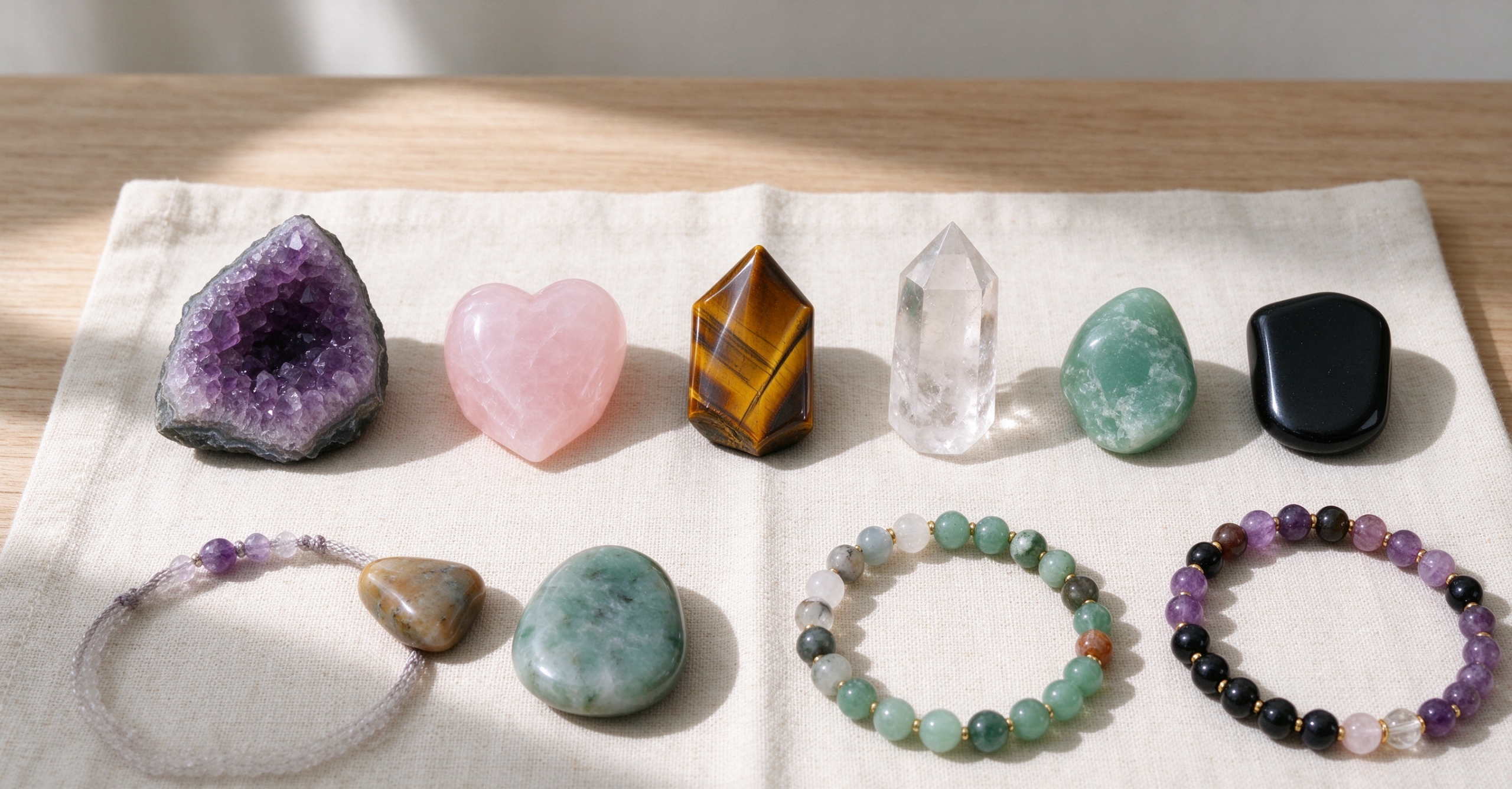
This guide is for that moment. I’ve gathered the stones our customers ask about most and put the basics in one place: where each one comes from, what different cultures have believed about it, how to tell if it’s real, and how to keep it looking good.
You won’t find medical or psychological promises here. Crystal meanings are stories and traditions, some of them thousands of years old. That history is exactly why I think they’re worth knowing. Treat them like a lucky charm or a note to yourself, not a treatment.
How to Choose a Crystal
There’s no wrong way to pick a stone, but a few approaches make it easier.
Start with what draws you. Plenty of collectors pick the stone they keep coming back to, the one whose color or glow they can’t stop looking at.
Pick a meaning that matches an intention. If you like the idea of a daily reminder, choose a stone whose traditional meaning fits what you want to focus on. In folklore, rose quartz goes with love and tiger eye with courage. Wearing one turns into a small daily ritual.
Think about how you’ll use it. A bracelet gets bumped, rinsed and sweated on. A sphere sits on a shelf. Softer stones like selenite belong in the second group. Harder quartz-family stones handle daily wear much better.
Check what you’re buying. Ask whether a stone is natural, treated or glass. Honest sellers will tell you. For some stones it matters a lot, and I’ll flag those below.
Amethyst
Meaning and lore
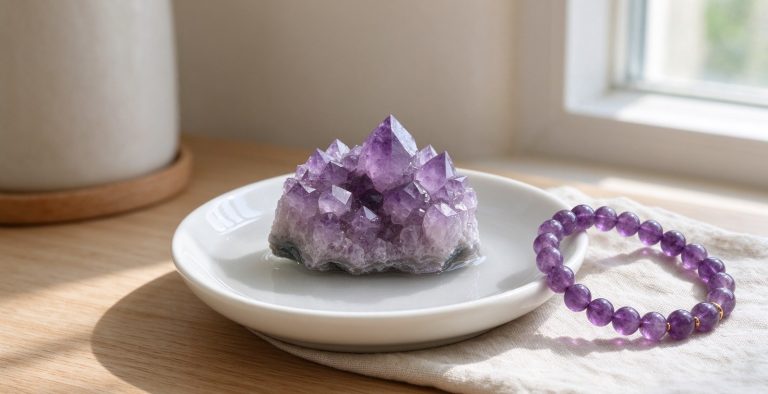
Amethyst’s name comes from the ancient Greek amethystos, roughly “not intoxicated.” Greek and Roman drinkers believed the stone kept a clear head, and some carved their goblets from it. Over the centuries the purple color became tied to royalty and the clergy. Amethyst rings have long been associated with bishops in some Christian traditions.
In modern crystal practice, amethyst stands for calm and reflection. It is also the traditional birthstone for February.
Color and origin
Amethyst is purple quartz. The shade runs from pale lilac to a deep grape, and the color comes from traces of iron in the crystal, modified by natural gamma radiation over millions of years. Much of the world’s supply comes from Brazil and Uruguay, where it often forms in large geodes, and from Zambia, which produces a deeper, more saturated purple.
How to tell if it’s real (and what treatments to ask about)
Most amethyst on the market is natural. Two things to know:
– Heat-treated amethyst = citrine. Deep orange “citrine” is almost always amethyst that has been heated. This is permanent and stable, but sellers should label it honestly.
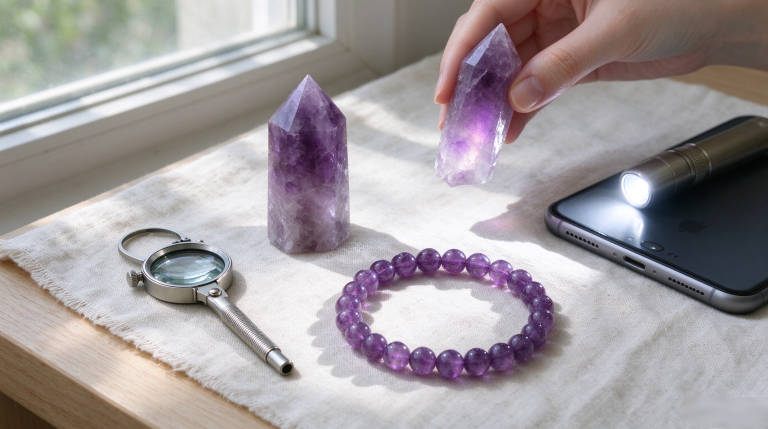
– Glass and dyed imitations. Real amethyst has uneven color zones and small inclusions. Glass amethyst has perfectly uniform color and often round bubbles inside. A suspiciously low price is worth a second look.
Want more detail?
Care note
Amethyst is fairly hard (7 on the Mohs scale), so a quick rinse in plain water is fine. Strong, direct sunlight is the bigger risk: over long periods it can fade the purple. Keep it on a shelf away from a sunny window.
How to wear or use it
Most people start with a beaded bracelet, and you can wear one every day without thinking about it. Try our geometric zircon amethyst beaded bracelet. If you prefer something closer to the raw stone, a raw amethyst cluster pendant keeps the natural crystal points. Many people keep a piece on the nightstand or desk to remind them to slow down.
Rose Quartz
Meaning and lore
Rose quartz is the stone people think of first for love. Greek and Roman myths connect it with Eros and Aphrodite, and one story says the stone turned pink when Aphrodite cut herself on a thorn while rushing to Adonis.
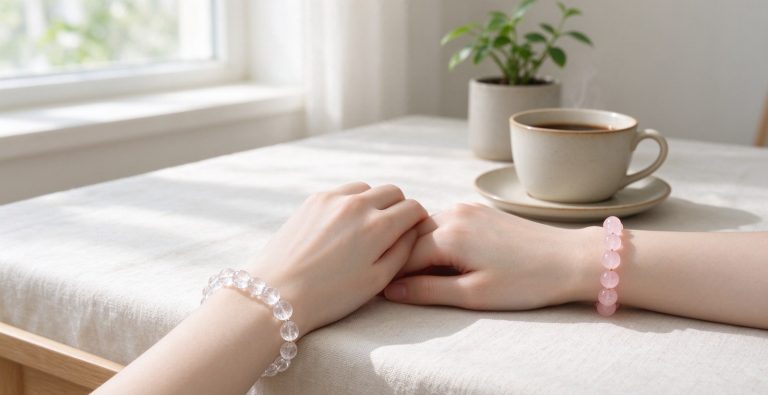
In modern crystal practice it’s tied to self-kindness and affection. That’s why so many people get it as a gift, often as their first crystal.
Color and origin
The soft pink comes from microscopic mineral fibers inside the quartz. Most rose quartz is cloudy rather than glass-clear, and I’d argue that milky glow is the best thing about it. Brazil and Madagascar are major sources.
How to tell if it’s real
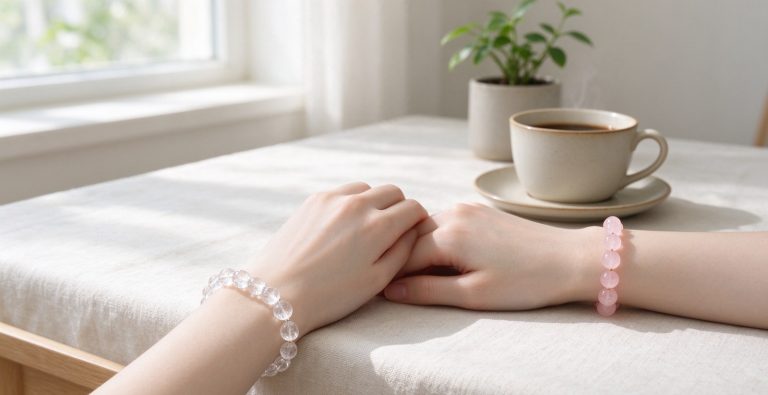
- Natural rose quartz is cloudy. If you see a fully transparent, glass-clear pink stone, it’s likely pink glass or synthetic quartz.
- Dyed quartz exists. Some sellers dye cheaper milky quartz to boost the pink. Real rose quartz has an even, milky transparency; dyed versions show concentrated color in cracks and crevices.
Care note
Rose quartz is hard and handles water well. Rinse it, wipe it, done. Like amethyst, it can lose some color after long exposure to strong sun, and sudden heat changes can crack it. Skip hot water.
How to wear or use it
A rose quartz pyramid is a popular piece for a bedroom or shared living space, which fits the stone’s traditional meaning. It’s also a good first stone for someone new to crystals.
Citrine
Meaning and lore
Citrine gets its name from the French citron, lemon. In crystal tradition it’s the “merchant’s stone,” and some shopkeepers keep a piece by the cash register as a symbol of abundance. It’s also linked with warmth and sunshine. It is one of the traditional birthstones for November.
Color and origin
Citrine is yellow to golden-orange quartz. Natural citrine is fairly rare and usually pale. Much of the deep orange citrine on the market is amethyst that has been heat-treated. If the seller says so up front, that’s fine. If they don’t, ask. Brazil supplies most of it.
How to tell natural from heat-treated citrine
- Natural citrine is pale, lemon-yellow, and often has white or cloudy areas near the base.
- Heat-treated amethyst tends to be a deeper orange-brown, often with reddish or smoky tones, and may still show purple zoning at the very tips.
- If a listing just says “citrine” without specifying, it’s worth asking the seller whether it has been heat-treated.
Care note
Citrine is quartz, so water is fine. Keep it out of prolonged direct sun, since the color can fade over time.
How to wear or use it
Citrine works well as a pocket stone or in a mixed bowl of tumbled crystal stones on a desk. That warm yellow cheers up a desk.
Clear Quartz
Meaning and lore
Ancient Greeks thought clear quartz was ice frozen so hard it would never melt. The word “crystal” itself comes from the Greek krystallos, ice. Crystal balls for scrying were traditionally carved from it.
In today’s crystal traditions it’s called the “master stone” and is linked with clarity and intention. People often pair it with other stones, believing it amplifies the meaning of the stone it’s paired with.
Color and origin
It’s colorless and often water-clear, sometimes with cloudy patches or tiny inclusions. Quartz is one of the most common minerals on Earth. Well-known sources include Brazil, Madagascar and Arkansas in the United States.
How to tell if it’s real
- Real quartz feels cool to the touch and warms slowly in your hand. Glass warms up much faster.
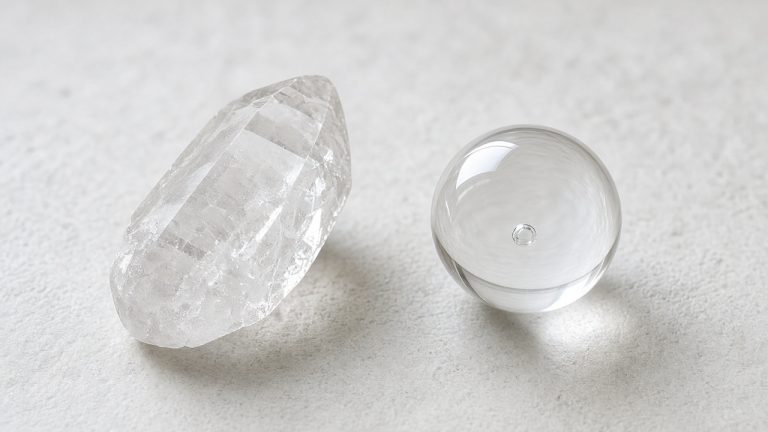
- Inclusions are normal. Natural clear quartz often has tiny veils, rainbow fractures or mineral lines. Perfectly clear, flawless “clear quartz” at a cheap price is likely glass.
- Round bubbles trapped inside mean glass. Natural quartz doesn’t have them.
Care note
Clear quartz is the low-maintenance stone here. It’s hard and water-safe, and sun won’t fade it. One caution: a clear sphere in direct sunlight can focus light like a magnifying glass, so don’t leave it on a sunny windowsill near fabric or paper.
How to wear or use it
A natural white crystal beaded bracelet pairs well with almost any other bracelet. For the home, a crystal sphere with stand or a crystal point wand looks great on a shelf.
Tiger Eye
Meaning and lore
Tiger eye’s golden stripes seem to shift as you turn it, like an eye opening. Roman soldiers are said to have carried it into battle for courage, and in many traditions it’s a stone of confidence and focus. It’s a common choice for men’s bracelets.
Color and origin
It’s golden brown with silky bands. The shimmer, called chatoyancy, comes from fibrous crocidolite that was replaced by quartz over time. South Africa is the best-known source.
How to tell if it’s real
- Real tiger eye has a silky, wavy chatoyant band that moves as you turn the stone.
- Glass imitations (sometimes called “tiger eye glass” or fiber-optic glass) have a very straight, uniform cat’s-eye line and feel lighter and hotter in hand.
- Cheaper beads may be dyed quartz. The color is too even and too bright, with no natural golden-to-brown variation.
Care note
Tiger eye is hard and stands up to daily wear. Wipe it with a damp cloth. Avoid harsh cleaners, which can dull the polish.
How to wear or use it
Bracelets are the most popular way to wear tiger eye, often mixed with darker stones. Browse our natural gemstone beaded bracelets for mixed-stone options.
Black Tourmaline
Meaning and lore
Black tourmaline, also called schorl, is one of the most popular “protection” stones in modern crystal practice. People place it by the front door or keep it in a pocket as a symbol of keeping negativity out. The name tourmaline is often traced to a Sinhalese word from Sri Lanka, where gem traders once sold many colors of the stone.
Color and origin
It’s opaque and glossy black, usually with ridges running along the length of the crystal. You’ll find it in Brazil, across Africa and well beyond.
How to tell if it’s real
- A fridge magnet won’t stick to black tourmaline, though a strong neodymium magnet may pull on it weakly. If an ordinary magnet grabs your stone firmly, it’s more likely magnetite or hematite, which are different black minerals.
- Real schorl has vertical ridges (striations) along the crystal. Black obsidian is smooth and glassy by comparison.
- Polished black tourmaline tumble stones are common; raw pieces show the characteristic prismatic shape.
Care note
It’s hard (around 7 to 7.5 on the Mohs scale), but raw pieces can be brittle along those ridges and may splinter if dropped. A quick rinse is fine. Dry it well.
How to wear or use it
Raw pieces work well near doorways or on a desk. Polished tumbled pieces are easier to carry.
Selenite
Meaning and lore
Selenite is named after Selene, the Greek goddess of the moon, for its soft pearly glow. In crystal tradition it’s linked with peace and light, and many collectors use a selenite plate as a resting place for their other stones. People call this “cleansing” or “charging.”
Color and origin
It’s white and translucent, with a silky, fibrous look. Selenite is a form of gypsum, not quartz. Large deposits are found in Morocco and Mexico.
How to tell if it’s real
- Real selenite is soft enough that a fingernail can scratch it (Mohs hardness 2). If your nail leaves a mark, that’s consistent with gypsum.
- White quartz or calcite imitations are much harder and won’t scratch under a fingernail.
- Selenite always has a fibrous, silky texture, never a glassy one.
Care note
Be careful with this one. Selenite is very soft and slightly water-soluble, so water can dull, pit or roughen its surface. Don’t soak or rinse it. Dust it with a dry cloth and keep it away from humid bathrooms.
How to wear or use it
Selenite is better at home than on your wrist. Use a plate or tower on a dresser, and set your bracelets on it overnight if you like the tradition.
Cat’s Eye
Meaning and lore
“Cat’s eye” describes an effect, not one single stone. A thin band of light slides across the surface when you move it, like a cat’s pupil. The most prized version, cat’s eye chrysoberyl, holds a special place in Vedic astrology, where it’s linked to the shadow planet Ketu. In folklore more broadly it’s seen as a watchful, protective stone.
Color and origin
The cat’s-eye effect, called chatoyancy, appears in several natural stones. The best known is chrysoberyl, which is honey to greenish yellow and comes mainly from Sri Lanka, India and Brazil. Quartz and some other minerals can show it too. It’s also made in fiber-optic glass, which can be produced in a wide range of colors. Both natural and man-made cat’s eye are popular in jewelry.
How to know what you’re buying
The light band, the color and the price all vary between materials, so the simplest step is to check the product listing for the material. If it isn’t stated, ask the seller.
Care note
Use mild soap, lukewarm water and a soft cloth. Dry it well, especially if the bracelet is strung on elastic.
How to wear or use it
Our cat’s eye gemstone bracelet shows off the shifting light best in daylight.
Chevron Amethyst
Meaning and lore
Chevron amethyst carries all of amethyst’s lore and adds a twist. Its V-shaped bands of purple and white are said in crystal tradition to combine amethyst’s calm with clear quartz’s clarity. Collectors like it because every piece has its own pattern.
Color and origin
It’s layered purple and white quartz in sharp V patterns. Much of it comes from Africa and Brazil.
Care note
Treat it like amethyst. It’s water-safe, but keep it away from long, direct sun to protect the purple bands.
How to wear or use it
Tumbled chevron amethyst makes a nice pocket stone, and points or towers show off the banding on a shelf.
Quick-Reference Table
| Stone | Color | Traditional meaning | Water safe? | Sun sensitive? | Mohs |
|---|---|---|---|---|---|
| Amethyst | Purple | Calm, reflection | Rinse OK | May fade | 7 |
| Rose quartz | Pink | Love, kindness | Rinse OK | May fade | 7 |
| Citrine | Yellow to orange | Abundance, warmth | Rinse OK | May fade | 7 |
| Clear quartz | Colorless | Clarity, intention | Rinse OK | OK (watch spheres) | 7 |
| Tiger eye | Golden brown | Courage, focus | Damp cloth | OK | 7 |
| Black tourmaline | Black | Protection | Rinse, dry well | OK | 7–7.5 |
| Selenite | White | Peace, light | Never | OK | 2 |
| Cat’s eye | Varies | Watchfulness, protection | Mild soap OK | OK | Varies |
| Chevron amethyst | Purple and white | Calm with clarity | Rinse OK | May fade | 7 |
Care Basics: Cleansing Crystals
People use “cleansing” for two different things.
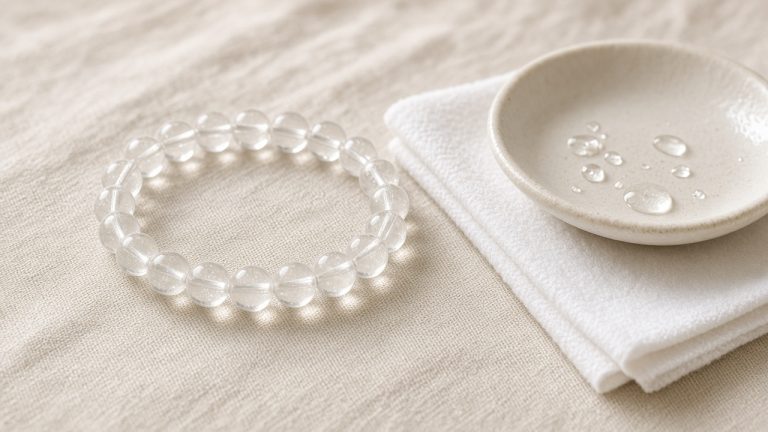
Physical cleaning is just keeping a stone clean. For most quartz-family stones, lukewarm water with a drop of mild soap does the job. Dry everything well, especially strung bracelets, because water weakens elastic cord over time. Skip ultrasonic cleaners and harsh chemicals.
Symbolic cleansing is a ritual from crystal tradition. People who follow it use a few common methods:
– Moonlight. Leave stones on a windowsill overnight, often during a full moon. This is safe for nearly every stone.
– Smoke. Pass the stone through incense or herb smoke.
– Sound. Ring a bell or singing bowl near your collection.
– A selenite plate. Rest stones on selenite overnight.
– Salt. Some people bury stones in dry salt. Avoid salt water, though. It can pit softer stones and corrode metal settings.
Whichever you choose, match the method to the stone. Selenite never gets wet. Purple and pink stones stay out of hard sun. Not sure? Go with moonlight. It’s the gentlest option.
Shop Our Crystal Collection
A few pieces from the shop that pair with this guide:
– Geometric zircon amethyst beaded bracelet
– Raw amethyst cluster pendant
– Natural rose quartz crystal pyramid
– Natural white crystal beaded bracelet
– Natural crystal sphere ornament with stand
– Natural crystal point wand obelisk
– Natural cat’s eye gemstone bracelet
– Natural gemstone beaded bracelet
– Natural tumbled crystal stones
– Raw crystal aromatherapy diffuser stone
FAQ
What are crystal meanings?
Crystal meanings are the symbolic associations that cultures and modern crystal practitioners have given to different stones, such as love for rose quartz or courage for tiger eye. They come from folklore, history and spiritual tradition. They aren’t scientific properties.
Which crystal is best for beginners?
Clear quartz and rose quartz are good starting points. Both are cheap, tough and fine with water. Amethyst is a close third if you can keep it out of strong sun.
Can I wear more than one crystal at once?
Yes. Plenty of people stack bracelets or carry a few tumbled stones together. In tradition, clear quartz is often paired with other stones.
Which crystals shouldn’t get wet?
Selenite is the main one in this guide, because it’s slightly water-soluble and water damages its surface. Other soft or porous stones, like malachite and turquoise, also shouldn’t be soaked. When you’re unsure, wipe instead of rinsing.
How can I tell if my crystal is real?
Natural stones usually have small inclusions, uneven color and a cool feel that warms slowly in your hand. Perfectly uniform color and round bubbles often point to glass. Ask the seller whether a stone is natural, treated or synthetic.
Disclaimer: The crystal meanings in this article describe traditional beliefs, folklore and cultural history. They are shared for educational and enjoyment purposes only. Crystals are not a substitute for professional medical, psychological or financial advice, and we make no claims that any stone can diagnose, treat, cure or prevent any condition.