How to Tell If Amethyst Is Real: 6 Simple Home Checks
Amethyst is everywhere, which is great news if you love purple stones. It also means a lot of purple glass gets sold under the same name.
The good news is that glass is usually easy to catch at home. You don’t need tools beyond your eyes, a phone flashlight and a bit of patience. The harder case is lab-grown amethyst, and I’ll be honest about where home checks stop working.
If you want the background on the stone itself first (the name, the lore, the February birthstone link), our crystal meanings guide covers it.
Natural, lab-grown and glass
Before testing anything, it helps to know what you might be holding.
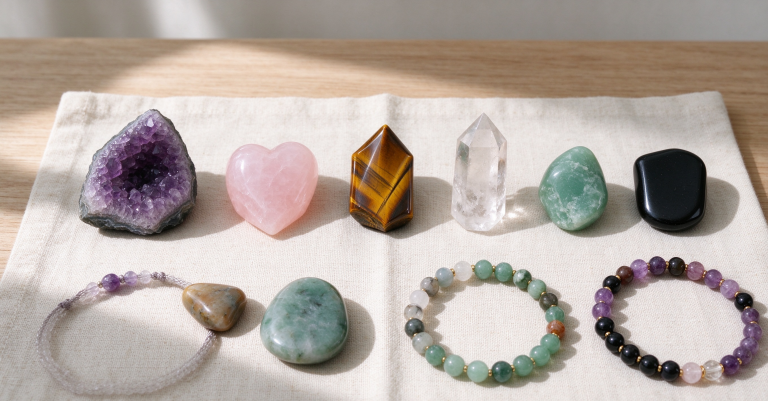
Natural amethyst is purple quartz that formed in the ground. It comes in raw clusters, points, tumbled stones and polished beads.
Lab-grown (synthetic) amethyst is real quartz too. It has the same chemistry and hardness as natural amethyst, but it was grown in a factory. Selling it is fine when the seller says so. The problem is when it’s sold as natural.
Glass is the most common imitation, especially in cheap beads. It’s softer, lighter in feel and often a little too perfect.
Most of the checks below are about spotting glass. Telling natural from lab-grown usually takes a gem lab.
6 home checks
No single check proves anything. Treat each one as a clue and look at them together.
1. Look at the color
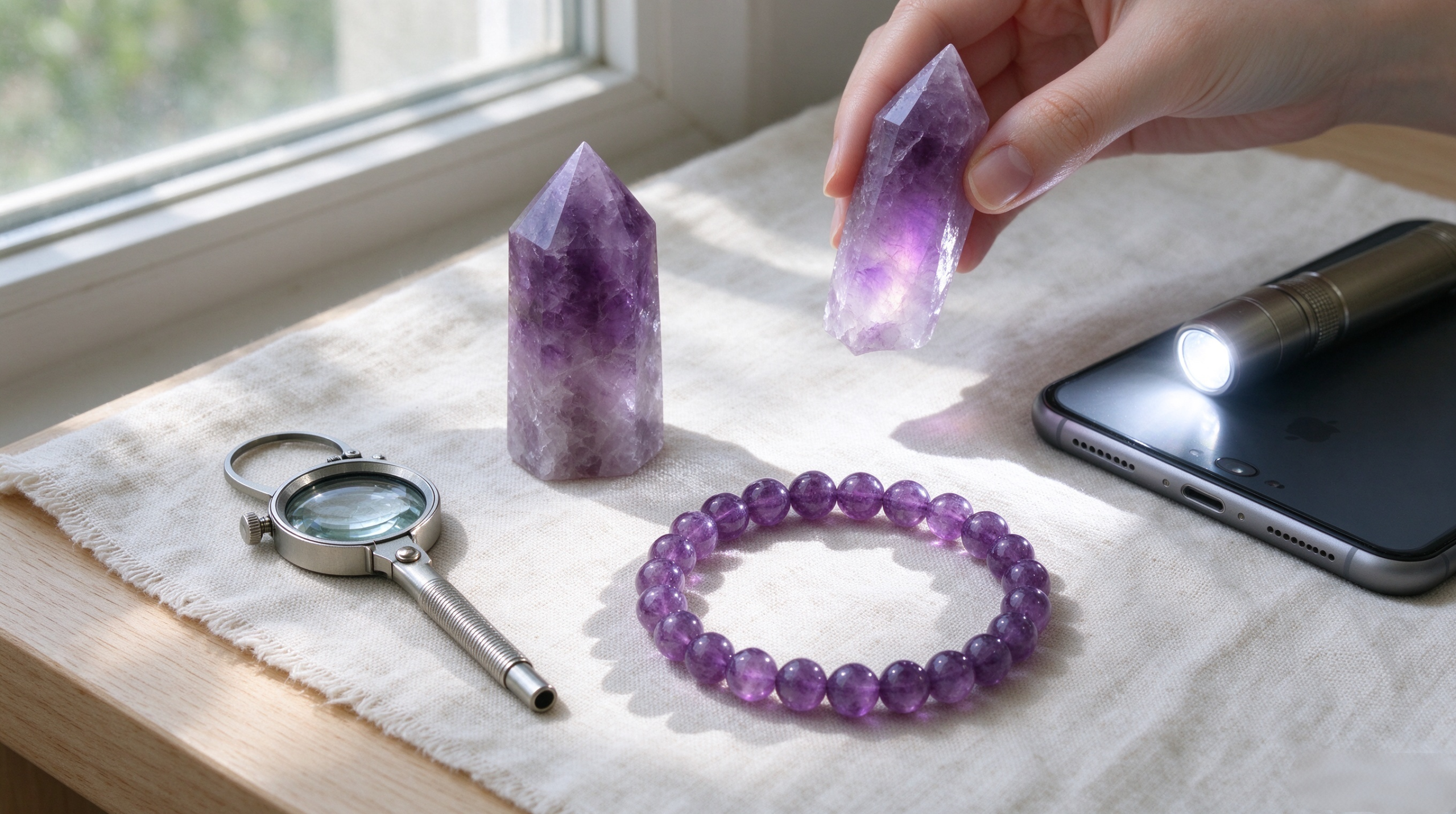
Hold the stone up to daylight or a white wall. Natural amethyst rarely has perfectly even color. You’ll often see lighter and darker patches, faint stripes, or deeper purple toward the tips of raw points.
Color that looks flat and identical from every angle is a reason to look closer. It isn’t proof, though. Polished beads are often sorted by color, so a well-matched bracelet can still be natural.
Watch out for color that sits only in the cracks. That’s a sign of dye, which is more common in very bright or very dark beads.
2. Check the inside
Shine a phone flashlight through the stone, or use the zoom on your camera. Natural amethyst often has small flaws inside: wispy veils, tiny cracks, or stripe-like patterns.
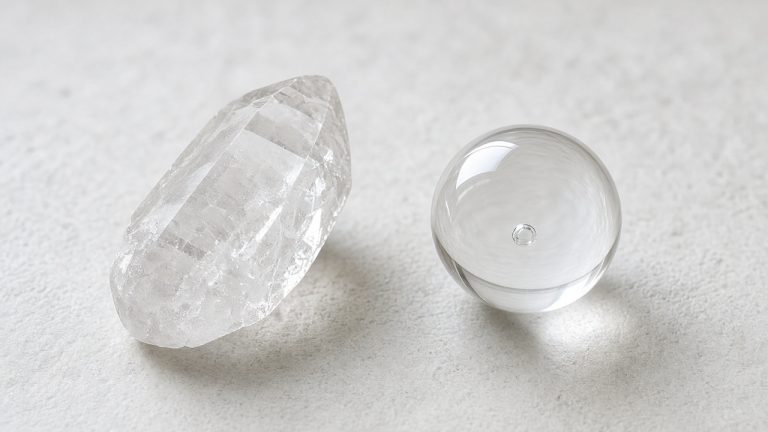
Glass tends to show different things. Look for perfectly round bubbles, often in small groups, and curved swirl lines like stirred syrup. Round bubbles are one of the clearest glass signs you can find at home.
A stone with no inclusions at all could be very clean natural amethyst, lab-grown, or glass. That’s where the other checks come in.
3. Feel the temperature
Pick the stone up from a cool room and hold it against your lip or the inside of your wrist. Quartz pulls heat away from your skin faster than glass does, so it feels cool at first and warms up slowly.
Glass feels less cold and warms up quicker. This check is easier if you have a piece of known quartz or a glass bead to compare against side by side.
4. Test the hardness (carefully)
Amethyst sits at 7 on the Mohs hardness scale. Most glass is around 5.5. That means real quartz can scratch ordinary glass, and a steel knife usually won’t mark real quartz.
If you try this, be gentle. Use a sharp edge of the stone on an old glass bottle you don’t care about, and press lightly. A real amethyst point should leave a fine scratch. Never scratch the face of a stone you plan to wear, and skip this test for beads and pendants altogether. A chipped bead is a high price for an answer.
5. Do a price sanity check
Natural amethyst isn’t rare, so it doesn’t have to be expensive. But very large, deep purple, clear stones at a tiny price deserve a second look. The same goes for a big lot of perfectly matched, glassy beads sold for almost nothing.
Low price alone doesn’t mean fake. It just means the other checks matter more.
6. Ask the seller
A clear product listing should tell you the material. If it says “amethyst” without saying whether the stone is natural, lab-grown, dyed or glass, ask. Sellers who know their stock can usually answer quickly. A vague reply, or a listing that changes its wording when you ask, tells you something too.
This applies to every shop, including ours. If a listing on our site leaves you unsure about something, message us before you buy.
Myths: the lighter test
You’ll see videos telling you to hold a flame under amethyst to see if it’s real. Please don’t.
Heat doesn’t prove anything about whether a stone is natural, and it can change amethyst’s color for good. In fact, much of the orange “citrine” on the market is amethyst that was heated on purpose. A flame can also crack stones that have internal fractures, and it will damage any cord, glue or plating on jewelry.
Other shortcuts don’t hold up well either. Rubbing a stone on your clothes, dropping it in water, or checking whether it “feels heavy” won’t give you a reliable answer.
When to see a gemologist
Home checks are good at catching glass. They’re not good at separating natural amethyst from lab-grown, because the two share the same chemistry and hardness. Gem labs use magnification and specialist instruments to look for growth patterns that home checks can’t see.
For an everyday bracelet or a small cluster, that’s rarely worth the cost. It’s worth it for a valuable piece, an heirloom, or anything sold to you with a big price tag and a strong claim.
FAQ
Does real amethyst feel cold?
Usually, yes. Quartz feels cool to the touch and warms up slowly in your hand. Glass warms up faster. It’s a useful clue but not a final answer.
Is the lighter test reliable?
No. Heat can fade or change amethyst’s color, crack stones with fractures, and ruin jewelry settings. It doesn’t prove whether a stone is real.
Are bubbles a sign of fake amethyst?
Perfectly round bubbles usually point to glass. Natural amethyst can have inclusions, but they tend to look like veils, cracks or stripes rather than round bubbles.
Can lab-grown amethyst be called real?
It’s real quartz, so it isn’t fake in the way glass is. But it isn’t natural, and a fair listing should say so.
Does real amethyst fade?
It can. Long periods of strong, direct sunlight can lighten amethyst over time. Our guide on how to cleanse amethyst covers safe care and storage.
Pieces mentioned in this guide
Disclaimer: The checks in this article are general, at-home guidance and can’t replace testing by a qualified gem lab. Crystal meanings mentioned on this site describe traditional beliefs and are shared for educational and enjoyment purposes only. Crystals are not a substitute for professional medical, psychological or financial advice.