Clear Quartz vs Glass: How to Tell If Your Clear Quartz Is Real
Quick answer: Perfectly round trapped bubbles and a piece that warms up fast lean toward glass. Natural inclusions, veils, and a cooler feel lean toward quartz. Home checks are clues, not lab proof. Read the product description and ask what you are buying.
Clear quartz and clear glass can look alike in a product photo. Both can be transparent, both can be cut into beads or points, and both show up in jewelry and decor. Shoppers searching “clear quartz vs glass” usually want a few practical checks before they buy or before they decide what they already own.
This guide mirrors the approach in our how to tell if amethyst is real post: simple observations first, honesty about limits, and no destructive tests on jewelry you care about.
Why clear quartz and glass get confused
Clear quartz is a mineral (silicon dioxide). Glass is a manufactured material. In jewelry language, “crystal” sometimes means leaded glass marketed as crystal glass. That naming overlap causes most of the mix-ups.
Photos flatten depth. Bright lighting hides bubbles. Identical machine-cut beads look “perfect,” which some people read as fake and others read as high quality. The fix is a few checks under real light, plus a seller who names the material plainly. Our materials page outlines how we describe what we sell.
What “crystal” means in jewelry ads
Product titles are inconsistent across the web. One seller uses “crystal” for mineral quartz. Another uses it for faceted glass. A third uses it as a style word for anything clear and shiny.
Before you run home checks, read the listing for plain material words: quartz, glass, crystal glass, acrylic, or “fashion jewelry.” If the page never names the material, treat that as a reason to ask. Identification guides help most when the seller already gave you a starting claim to verify.
Side-by-side comparison
Use several rows together. One clue alone is rarely enough.
| Clue | Typical quartz | Typical glass | Confidence |
|---|---|---|---|
| Bubbles | Rarely round gas bubbles; may show irregular voids | Perfectly round bubbles, often in groups | Medium-high for round bubbles |
| Inclusions | Veils, fractures, wispy clouds, faint growth lines | Curved swirl lines; few natural-looking veils | Medium |
| Clarity | Can be clear or slightly cloudy | Often very even and “perfect” | Low alone |
| Temperature | Often cooler; warms slower in the hand | Warms to skin temperature faster | Low-medium |
| Hardness (Mohs) | About 7 | Common glass about 5-5.5 | Medium only on scrap samples |
| Bead uniformity | Natural variation bead to bead is common | Near-identical beads plus bubbles raise questions | Medium for bracelets |
| Price red flags | Realistic for size and finish | “Too cheap for the size” plus perfect clarity | Low (qualitative only) |
Check 1: Look for round bubbles
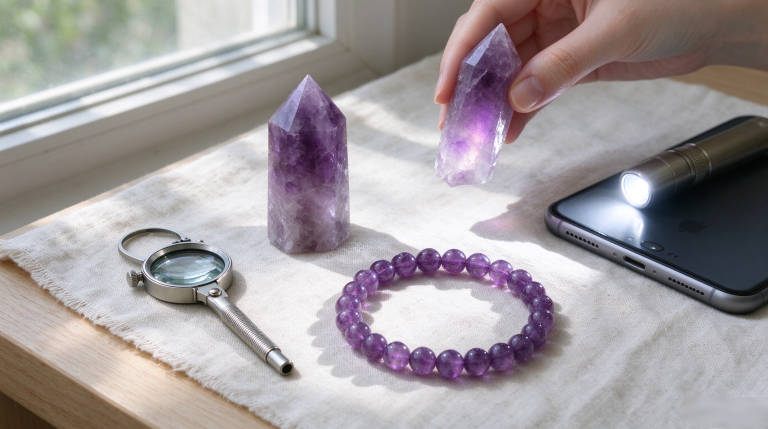
Use a phone flashlight and, if you have one, a small loupe. Shine light through the piece and look inside, not only at the surface.
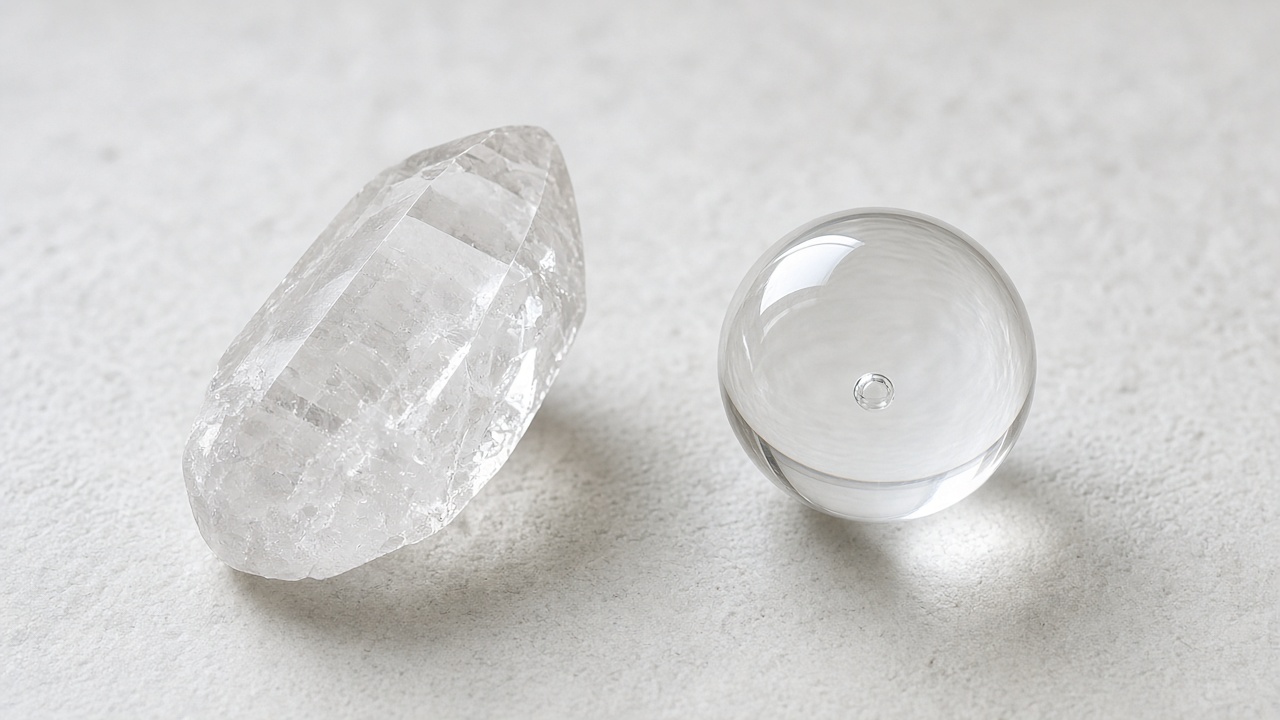
Glass often traps gas as neat spheres. Those round bubbles are one of the stronger DIY clues. Quartz can have irregular cavities or healed fractures, but rows of tiny perfect spheres usually point to glass.
Curved swirl lines that look like stirred syrup also lean glass. Take your time. Reflections on polished facets can mimic bubbles until you change the angle.
Using a phone camera as a loupe
You do not need a gem lab kit. Open your phone camera, turn on the flashlight of a second phone or a desk lamp, and zoom into the interior of a bead or point. Take a still photo, then zoom the photo. Round bubbles and curved swirls are often clearer in a photo than with the naked eye under mixed room light.
Clean the surface first with a dry cloth so dust does not look like inclusions. Change the angle twice. Surface reflections move; trapped bubbles stay put inside the material.
Check 2: Inclusions and growth character
Natural clear quartz frequently shows something inside: faint veils, needle-like marks, cloudy patches, or fracture planes. The piece does not need to look “flawed” to be quartz, and perfect clarity does not automatically mean glass.
Still, a stone that looks optically empty in every lighting condition deserves a closer look at the listing. Ask whether the seller means mineral quartz or crystal glass. For style and folklore context (not identification), see crystal meanings.
Check 3: Cool-to-touch (and its limits)
Quartz often feels cooler than glass of a similar size and stays cool a bit longer in your hand. Room temperature, how long the piece sat in a warm pocket, and whether you compared two objects of the same size all change the result.
Treat temperature as a supporting clue. Pair it with bubbles and inclusions. Do not use it as a single yes/no test.
When you compare two objects for the temperature check, use similar mass. A large glass paperweight will stay cool longer than a tiny quartz bead simply because of size. Match like with like, or the “cool test” misleads you.
Check 4: Hardness (only with caveats)
On the Mohs scale, quartz sits near 7. Ordinary window-type glass sits lower, around 5 to 5.5. In theory, quartz can scratch glass.
In practice:
- Never scratch a finished bracelet, pendant, or sphere you want to keep.
- Hardness tests belong on scrap samples, not on jewelry.
- Coatings, soft glass types, and synthetic quartz confuse casual scratch tests.
If you only have the jewelry in hand, skip hardness and stick to optical and feel checks.
Lab-grown quartz and coated glass (where DIY stops)
Home checks are best at catching ordinary glass. They are weaker against:
- Lab-grown (synthetic) quartz, which is chemically quartz
- Glass with coatings that change surface feel
- Leaded crystal glass cut to look like a mineral point
If the question is natural vs lab-grown quartz, a gemological lab is the honest next step. If the question is quartz vs common glass jewelry, bubbles, inclusions, and feel usually get you close enough for everyday shopping decisions.
Checks to skip
Search autocomplete still suggests testing clear quartz “with fire.” Skip flame and lighter tests. They can crack the piece, scorch cord or plating, and burn you. They are not a safe identification method.
Also skip drop tests and scratching the jewelry itself. Damage is permanent. Identification is not worth a broken bead strand.
Special case: clear quartz bead bracelets
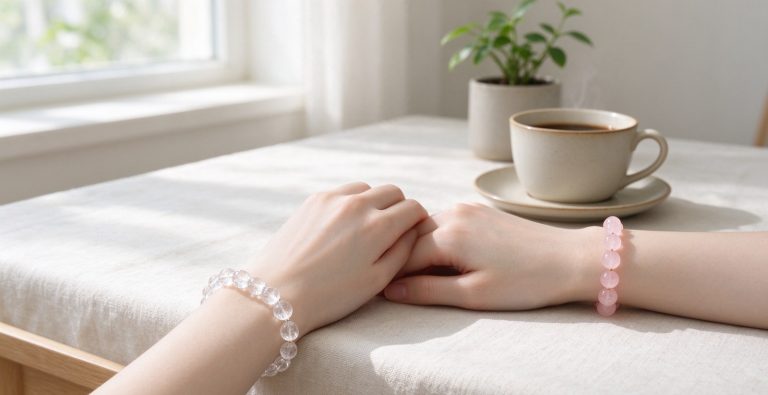
Beads hide clues between drill holes and stringing. Under bright light, roll the bracelet slowly:
- Look for round bubbles inside individual beads
- Compare bead-to-bead color and clarity (some natural variation is normal)
- Check whether every bead looks machine-identical with glass-like swirls
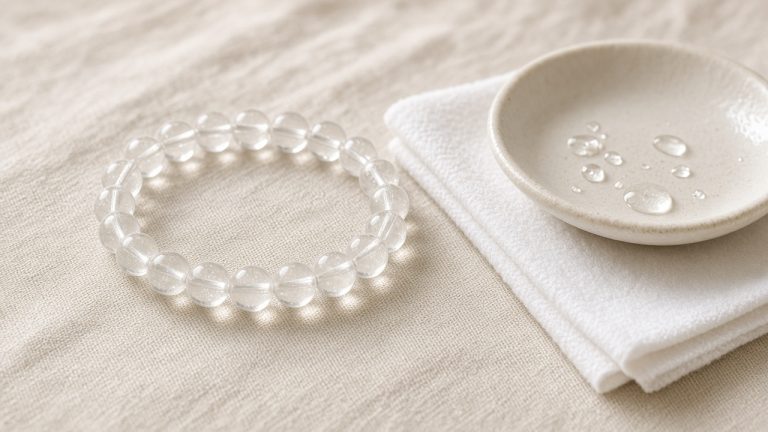
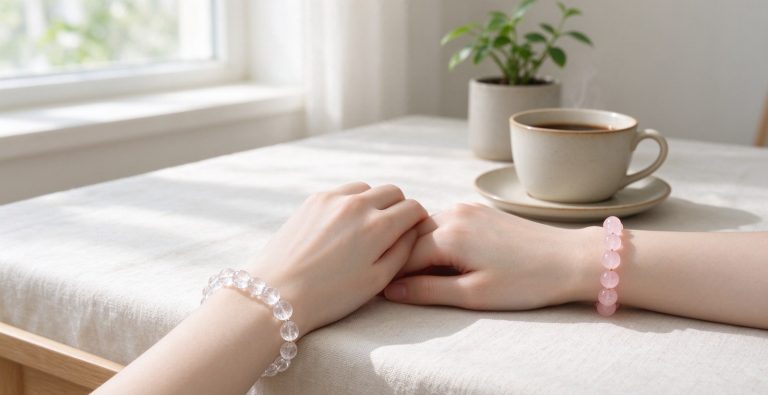
Examples from our shop: the natural white crystal beaded bracelet is listed as a crystal / quartz-style bead piece. By contrast, the faceted clear crystal stretch bracelet with gold accents is imitation crystal / glass (fashion jewelry)—use it as a glass-side comparison, not as clear quartz. That product page covers multiple styles; read the variant details. Browse more in the bracelets category.
Special case: points, spheres, and pendants
Larger forms show inclusions more easily than tiny beads.
- Points and towers: check the interior along the length under a flashlight. See our crystal point wand / obelisk.
- Spheres: rotate under light; glass spheres often reveal bubbles near the surface. See the crystal sphere with stand.
- Pendants: support the piece and inspect the stone separately from the cord. The raw crystal column pendant is one example of a point-style pendant.
- Tumbled lots: expect piece-to-piece variation in a pack such as our tumbled crystal stones.
What Zestnook lists as clear quartz
We label products by the materials described on each page. Clear and white crystal jewelry and decor above are listed as crystal / quartz-family pieces on their product pages—except the faceted clear crystal stretch bracelet, which is listed as imitation crystal / glass, not mineral quartz. We avoid absolute authenticity slogans on product pages. Read the title, description, and any variant notes before you buy, and use the checks in this article if you are comparing a piece you already own to glass.
Related: amethyst identification
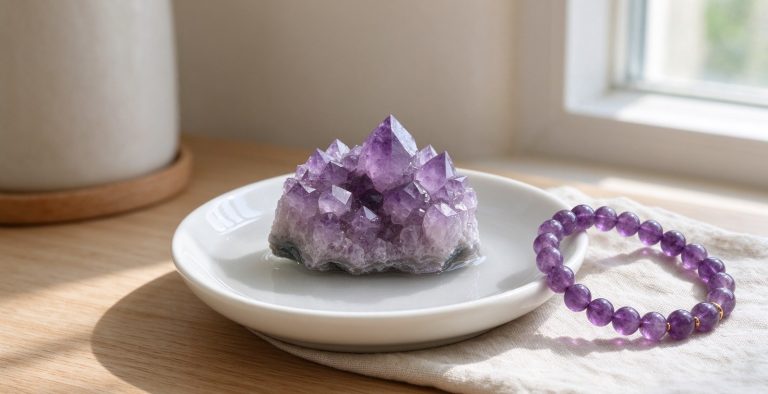
Purple quartz has its own common glass lookalikes. For color zoning, inclusions, and the same “skip destructive tests” approach, use How to Tell If Amethyst Is Real.
FAQ
How can you tell clear quartz from glass?
Look for round gas bubbles (glass) versus natural veils or inclusions (quartz), compare coolness to the touch, and read the seller’s material description. Use several clues together.
Does real clear quartz have imperfections?
Often yes. Tiny inclusions or faint cloudiness are common. Perfect clarity alone does not prove glass, but it should not stop you asking questions.
Will real quartz scratch glass?
Quartz is harder than ordinary glass on the Mohs scale, but do not scratch finished jewelry to find out.
How do I know if a clear quartz bracelet is real?
Check bead-to-bead variation, inspect for bubbles under light, and trust listings that name the material plainly.
Can I use a lighter to test clear quartz?
No. Flame tests can damage the piece and are unsafe. Skip them.
Is “crystal glass” the same as clear quartz?
No. Crystal glass is still glass. Clear quartz is a mineral (silicon dioxide).
Are home tests enough?
They are helpful clues, not certificates. When it matters, buy from sellers who disclose materials.
Shop clear quartz-style pieces
Start with the white crystal beaded bracelet, a point / tower, or the sphere with stand. Free shipping on $99.99+ where available (confirm at checkout).
Note: Folklore and style notes elsewhere on the site are not health claims. This article is about visual and practical identification only.